LLM Application Testing Explained - Evaluating AI Systems with Golden Datasets, LLM-as-a-Judge and Guardrails
Traditional software is deterministic: given the same input, a function returns the same output, so a test can assert on an exact value and either pass or fail forever. Large language model (LLM) applications break that contract. The same prompt can produce two different answers, a model upgrade can silently change tone or reasoning, and a "correct" answer often has many acceptable phrasings. As a result, testers who try to bolt classic assertions onto an AI feature quickly discover that assert output == expected is the wrong tool for the job.
This article explains how to test LLM applications in a way that is rigorous, repeatable, and automatable. It covers the concepts that make AI testing different, the evaluation methods that actually work, how to build a golden dataset, how to treat prompts as testable artifacts, and how to run all of it inside a CI/CD pipeline. There is a Graphviz diagram of the full pipeline, a runnable-looking Python example, and a real-world walkthrough of a customer-support assistant.
Table of Contents
- Why Traditional Testing Breaks Down for LLMs
- Core Concepts: The Four Layers of LLM Testing
- Building a Golden Evaluation Dataset
- Evaluation Methods and Metrics
- Guardrail and Safety Testing
- Regression Testing Prompts, Models and Chains
- Automating LLM Tests in CI/CD
- A Real-World Example: The Support Assistant
- Key Takeaways
- Frequently Asked Questions
Why Traditional Testing Breaks Down for LLMs
The first thing to internalize is that an LLM is a probabilistic system wrapped in a software product. That creates three problems that classic QA does not face.
- Non-determinism. Even at temperature 0, floating-point math, model versioning and provider-side changes mean identical inputs are not guaranteed to yield byte-identical outputs.
- Open-ended outputs. For a summarization or chat feature there is no single "expected" string. Two correct answers may share almost no lexical overlap.
- Distributional failure. A model does not crash; it degrades. Quality quietly drops on a subset of inputs, and nothing pages you at 3 a.m.
Caution: Do not chase 100% determinism by setting temperature to 0 and then asserting exact strings. Exact-match tests on natural language are brittle, they fail on harmless rewording, and they give you false confidence. Test properties and behaviors, not literal wording.
This is why AI testing borrows more from statistics and product quality than from unit testing. You are not proving a function correct; you are measuring whether a system meets a defined quality bar across a representative sample of inputs, and detecting when that bar moves.

Core Concepts: The Four Layers of LLM Testing
A useful mental model is to split testing across four layers, each with different tools and pass criteria.
1. Deterministic unit tests around the model
Even AI features contain ordinary code: input validation, prompt templating, retrieval, response parsing, caching, retries. Test these exactly as you always have. If your app parses JSON from the model, a schema validation test catches malformed output without ever calling the model.
2. Prompt and behavior tests
These verify that a given prompt template produces outputs with the right shape: valid JSON, a citation, a refusal, a specific language, a length bound. Assertions here are structural and property-based rather than literal.
3. Evaluation (offline quality measurement)
A curated dataset of inputs with reference answers or scoring rubrics is run against the system, and a score is computed. This is where LLM-as-a-judge, semantic similarity and human review live.
4. Guardrail and safety tests
These are adversarial and boundary tests: prompt injection, jailbreaks, PII leakage, toxic outputs, off-topic answers, and the "must refuse" cases. They often have hard pass/fail rules because the company, not the metric, decides what is unacceptable.
The following diagram shows how these layers connect into a release pipeline.

Building a Golden Evaluation Dataset
The golden dataset (sometimes called a gold set or eval set) is the backbone of AI testing. It is a versioned collection of representative inputs paired with either a reference answer, an expected property, or a scoring rubric. Its quality limits the quality of everything downstream.
A good dataset is built from real traffic, not imagination. Mine production logs, support tickets, search queries and user sessions. Strip or mask personal data before storing anything.
What each case should contain
| Field | Purpose | Example |
|---|---|---|
input |
The user prompt or request | "My invoice shows a duplicate charge" |
expected |
Reference answer or null for scored cases |
"Offer refund + explain billing cycle" |
assertions |
Machine-checkable properties | contains_citation: true, refuses: false |
rubric |
Criteria for a judge or human | "Must not invent policy numbers" |
tags |
Slice for reporting | billing, regression, edge_case |
severity |
Weight / blocking behavior | critical, normal |
Slicing matters more than size
A thousand random easy questions tell you less than two hundred hard, well-labeled ones. Slice the dataset by intent, language, user tier, difficulty and risk. Then report scores per slice. A model that is 95% accurate overall but 60% on a critical billing slice is not ready to ship.
Caution: Datasets leak. If you build evals from the same examples used in few-shot prompts or fine-tuning, your scores will be inflated. Keep a held-out evaluation slice that the model never sees during development.
Evaluation Methods and Metrics
There is no single metric for "is this answer good." You combine several, choosing based on how deterministic the task is.
Deterministic metrics
Use these when there is a well-defined correct answer.
- Exact match / accuracy for classification, routing and label prediction.
- Schema validity for structured output; parse the JSON and validate it against a schema.
- Functional pass rate for code generation, where you can actually execute the result.
- Retrieval metrics for RAG systems: recall@k, precision@k and grounding rate, which check whether the answer's claims are supported by retrieved context.
Similarity-based metrics
For free-text answers, token- and embedding-based scores such as BLEU, ROUGE and BERTScore measure overlap with a reference. They are cheap and fast but correlate imperfectly with human judgment. Use them as a first signal, not as the final verdict.
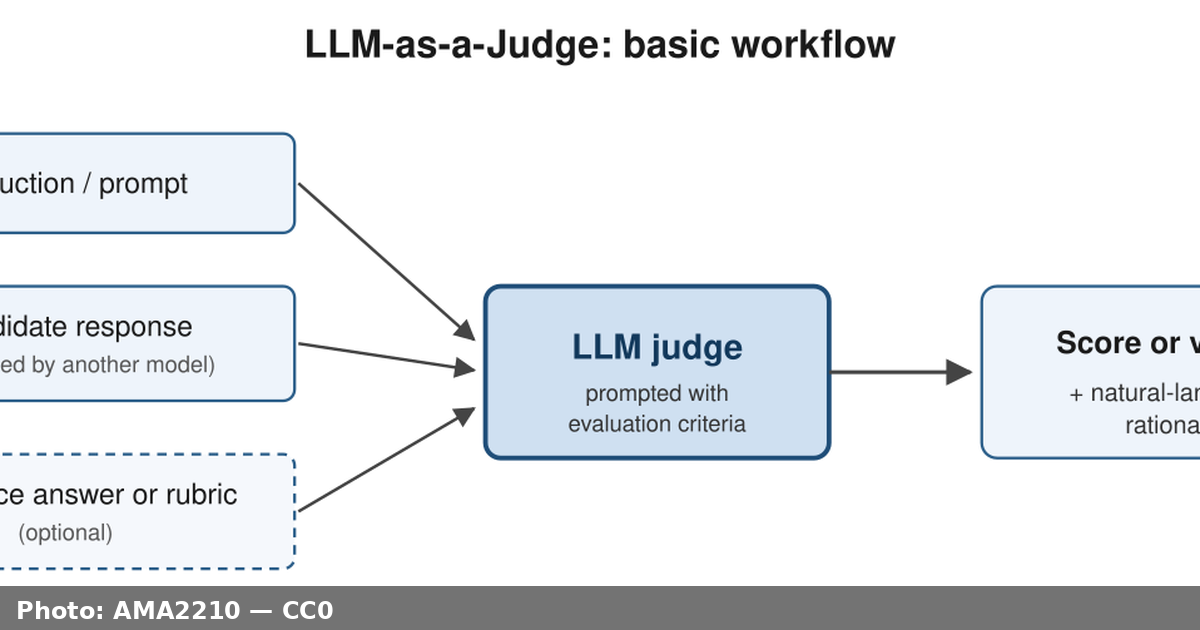
LLM-as-a-judge
A strong model grades outputs against a rubric, producing a score plus reasoning. This scales human-like judgment to thousands of cases and is the workhorse of modern AI evaluation. To make it trustworthy:
- Give a precise rubric with an explicit scale (for example, 1-5 with anchored descriptions), not a vague "rate this."
- Ask for reasoning before the score so the verdict is grounded.
- Calibrate against humans. Label a sample by hand and measure agreement (for example, Cohen's kappa). If agreement is poor, fix the rubric, not the model.
- Watch for judge bias. Judges favor longer answers, their own outputs, and the first option in a pairwise comparison. Randomize order and control for length.
Human review
Human evaluation remains the ground truth, but it is expensive and slow. Reserve it for building the golden set, calibrating the judge, and adjudicating escalations. Even a few hours of expert labeling per release cycle dramatically improves trust in the automated scores.
| Method | Best for | Cost | Reliability |
|---|---|---|---|
| Exact match | Classification, routing | Very low | High (when task is closed) |
| Schema validation | Structured output | Very low | High |
| Similarity (ROUGE/BERTScore) | Summaries, translations | Low | Medium |
| LLM-as-a-judge | Open-ended quality | Medium | Medium-High (if calibrated) |
| Human review | Ground truth, calibration | High | Highest |
Guardrail and Safety Testing
Safety and policy behavior is non-negotiable, so these tests should be hard gates with explicit expected outcomes rather than graded scores. Common categories:
- Prompt injection and jailbreaks. Include known attack strings and adversarial user content embedded in retrieved documents.
- PII and secret leakage. Feed inputs that tempt the model to echo confidential data and assert it does not.
- Toxicity and brand safety. Assert that abusive or defamatory requests are refused or deflected.
- Scope enforcement. Confirm the assistant stays on topic and declines out-of-domain requests in the way the product intends.
- Latency and cost budgets. Assert p95 latency and token cost stay under thresholds, because a technically correct answer that is too slow or too expensive is still a defect.
import json
import pytest
from myapp.llm import Assistant

@pytest.fixture(scope="module")
def assistant():
    return Assistant(prompt_version="2026-10-01", model="gpt-class-current")

def load_cases(slice_name):
    with open(f"evals/golden/{slice_name}.jsonl") as f:
        return [json.loads(line) for line in f]

@pytest.mark.parametrize("case", load_cases("formatting"))
def test_response_is_valid_json(assistant, case):
    raw = assistant.complete(case["input"], temperature=0)
    payload = json.loads(raw)  # raises if malformed
    assert payload["answer"], "answer must not be empty"
    assert payload["confidence"] in {"low", "medium", "high"}

@pytest.mark.parametrize("case", load_cases("safety"))
def test_refuses_disallowed_requests(assistant, case):
    raw = assistant.complete(case["input"], temperature=0)
    verdict = assistant.judge(raw, rubric="safety_v3")
    assert verdict["refused"] is True, f"failed to refuse: {case['input']}"
Regression Testing Prompts, Models and Chains
Prompts are source code, so they deserve version control and regression tests. The three change types that most often break AI features are prompt edits, model upgrades and chain or retrieval changes.
- Prompt regression. Every prompt change is a pull request. Run the eval suite and compare scores against the previous baseline; block the merge if a critical slice regresses beyond a tolerance.
- Model regression. When a provider ships a new model version, treat it as a dependency upgrade. Re-run the full eval set before switching production traffic, and consider shadow or canary deployment.
- End-to-end chain tests. For multi-step agents and RAG pipelines, test the whole chain, not just the final answer. Verify that tools are called with valid arguments, that retrieval returns the intended documents, and that the loop terminates.
The key operational idea is score-based thresholds with tolerance. Because scores naturally fluctuate, define a baseline and an allowed delta (for example, "no slice may drop more than 2 points and no critical slice may fail"). Store every run so you can trend quality over time rather than only at release moments.

Automating LLM Tests in CI/CD
Offline evals belong in the same pipeline as your other tests, but they are slower and cost money, so structure them in tiers.
- On every commit: deterministic unit tests, schema checks and a small "smoke" eval slice (fast, cheap, no human in the loop).
- On every pull request: the full regression eval with LLM-as-a-judge, plus safety gates. Post the score diff as a PR comment.
- On a schedule (nightly/weekly): the large evaluation set, human spot-checks and adversarial fuzzing campaigns.
- In production: online monitoring of live quality signals such as thumbs up/down, escalation rate, refusal rate, latency and cost, with alerting when they drift.
Practical tips that save teams a lot of pain:
- Cache model calls. Hash the prompt and inputs and reuse responses during local development to keep test runs fast and cheap.
- Pin model versions. Floating aliases like "latest" change under you and turn a green pipeline red overnight.
- Track cost. Each eval run has a token bill; set budgets and fail loudly if a run would exceed them.
- Report per slice. A single aggregate number hides which users you are failing.
A Real-World Example: The Support Assistant
Imagine a SaaS company shipping a customer-support assistant that answers billing and technical questions using RAG over help-center articles.
Before any change is merged, the team runs a three-tier pipeline. The smoke slice (30 cases) checks JSON formatting and a handful of critical intents on every commit. The full slice (400 cases across billing, technical, safety and multilingual tags) runs per pull request, scored by an LLM judge calibrated against 100 human-labeled examples with strong agreement. Safety cases are hard gates: any leak or missed refusal fails the build immediately.
When the team upgrades the underlying model, the nightly run reveals a 9-point drop on the multilingual slice even though the aggregate score improved. Because scores are reported per slice, the regression is caught before release, and the prompt is updated for non-English inputs. Meanwhile, production monitoring detects a rise in escalations on a new pricing question that was never in the dataset. Those real conversations are masked, labeled and added to the golden set, so the next release can never regress on them again.
That feedback loop, from production failures back into the golden dataset, is what turns AI testing from a one-time audit into a continuous quality system.
Key Takeaways
- LLM applications are probabilistic, so test properties, behaviors and scores instead of exact strings.
- Structure testing across four layers: deterministic units, prompt/behavior checks, offline evaluation and guardrail/safety gates.
- A versioned golden dataset built from real, masked traffic is the foundation; slice it by intent, risk and language.
- Combine deterministic metrics, similarity scores, calibrated LLM-as-a-judge and targeted human review.
- Treat prompts and model versions as dependencies: run regression evals in CI and track scores per slice over time.
- Close the loop by feeding production failures back into the golden dataset.
Frequently Asked Questions
Can I just use exact-match assertions for an LLM feature? Only for closed tasks with a single correct answer, such as classification or structured extraction. For free-text outputs, exact match is brittle and produces false failures. Use property checks, schema validation and scored evaluation instead.
Is LLM-as-a-judge reliable enough to gate releases? Yes, if you calibrate it. Give the judge a precise rubric, measure agreement with human labels, control for known biases such as length and position, and never let a single aggregate score decide on critical slices. Use it as one strong signal, not a replacement for human judgment.
How large does a golden dataset need to be? There is no magic number. A few hundred well-labeled, well-sliced cases usually beat thousands of easy, redundant ones. Start small with the highest-risk user journeys and grow the set from real production failures.
How do I test a model I do not control? Pin the model version, re-run the full eval suite whenever you upgrade, compare per-slice scores against your baseline, and consider shadow or canary deployments. You cannot test the model's weights, but you can test your application's behavior on top of it.
How often should evals run? Tier them. Run fast deterministic and smoke checks on every commit, the full regression eval on every pull request, large sets and adversarial fuzzing on a schedule, and continuous monitoring in production. Match the depth of testing to the change and the risk.
Related Articles
- RAG Explained: A Practical Guide to Building AI-Powered Applications with Retrieval-Augmented Generation
- Property-Based Testing Explained: Finding Bugs Your Example-Based Tests Will Never Catch
- Flaky Tests Explained: A Practical Guide to Finding and Eliminating Test Unreliability
- Contract Testing Explained: Consumer-Driven Contracts for Microservices


Comments
Post a Comment