WASI Explained: The Standard That Brings WebAssembly Beyond the Browser

WebAssembly was born in the browser, but it never wanted to stay there. Developers quickly realized that a fast, portable, sandboxed binary format had enormous potential beyond JavaScript runtimes — in edge computing, serverless functions, plugin systems, IoT devices, and even blockchain smart contracts. The missing piece was a standard way for WebAssembly modules to interact with the outside world: files, network sockets, clocks, random number generators, and environment variables.
That missing piece is the WebAssembly System Interface, or WASI. Created by the Bytecode Alliance and now under active development as a set of standardized preview2 APIs, WASI gives WebAssembly modules a consistent, secure system interface that works identically across operating systems and hardware architectures. It transforms WebAssembly from a browser technology into a genuinely universal bytecode format.
In this article, we will explore what WASI is, how it differs from raw WebAssembly, why it matters for modern software development, and how you can start using it today.
Table of Contents
- What Is WebAssembly, Quick Recap
- The Problem WASI Solves
- How WASI Works
- WASI Preview1 vs Preview2
- WASI Components and the Component Model
- WASI in Practice: Real-World Use Cases
- WASI Runtimes and Toolchains
- Security Model and Sandboxing
- WASI vs Docker vs Native Binaries
- Getting Started: Your First WASI Module
- Key Takeaways
- Frequently Asked Questions
What Is WebAssembly, Quick Recap
WebAssembly (Wasm) is a compact, portable binary instruction format. It defines a stack-based virtual machine that can execute code at near-native speed. Originally designed as a compilation target for languages like C, C++, and Rust to run inside web browsers, Wasm quickly proved useful outside that context because of three properties:
- Portability: A single Wasm binary runs on any CPU architecture and operating system.
- Sandboxing: Modules execute in an isolated environment with no default access to the host system.
- Performance: Wasm execution is only marginally slower than native code thanks to JIT and AOT compilation.
However, raw WebAssembly modules cannot do anything useful in isolation. A module compiled from C++ might contain calls to open(), read(), write(), and close(), but the Wasm specification says nothing about what those functions mean at the system level. This is where WASI enters the picture.
The Problem WASI Solves
Without a standard system interface, every WebAssembly runtime invented its own way to let modules interact with the host. Wasmtime had one approach, Wasmer another, and browser engines yet another. This fragmentation meant developers had to tailor their builds to specific runtimes, defeating the entire promise of write-once-run-anywhere.
WASI solves this by defining a standardized API surface that all compliant runtimes implement. When you compile a program to WASI, it produces a Wasm module that calls well-known WASI functions. Any WASI-compatible runtime can then execute that module with confidence that I/O, clock access, randomness, and environment variables all behave consistently.
Key Insight: WASI does not replace WebAssembly. It is a standard API layer built on top of Wasm that gives modules a predictable, secure way to interact with the host operating system.
How WASI Works
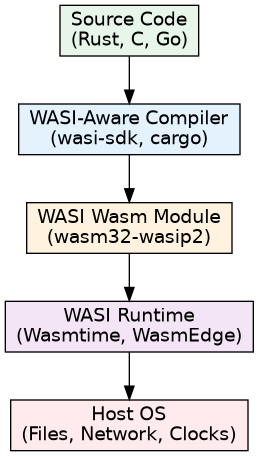
WASI modules communicate with the host through a set of WASI interfaces defined using the WIT (WebAssembly Interface Types) language. Each interface specifies functions that a module can import from the host runtime.
At its core, a WASI module:
- Is compiled from a source language (Rust, C/C++, Go, Zig, etc.) targeting the
wasm32-wasip1orwasm32-wasip2triple. - Imports WASI interfaces like
wasi:filesystem,wasi:sockets,wasi:clocks, andwasi:random. - Executes inside a WASI-compliant runtime that provides sandboxed implementations of those interfaces.
- Returns results through WASI-defined return types, including rich error handling.
Core WASI Interfaces
The WASI preview2 specification defines several essential interfaces:
| Interface | Purpose | Example Functionality |
|---|---|---|
wasi:filesystem |
Filesystem access | open, read, write, stat, readdir |
wasi:sockets |
Network sockets | TCP/UDP connections, address resolution |
wasi:clocks |
Time access | Monotonic clocks, wall clocks |
wasi:random |
Randomness | Cryptographic and non-deterministic randomness |
wasi:environment |
Environment variables | Reading env vars |
wasi:stdio |
Standard I/O | stdin, stdout, stderr |
wasi:process |
Process control | Exiting, argument passing |
wasi:io |
I/O primitives | Pollable futures, streams |
Each of these is an interface in the WIT sense, meaning it defines a set of typed functions with well-specified semantics and error handling.
WASI Preview1 vs Preview2
WASI has gone through a significant evolution:
Preview1 (Legacy)
Preview1 was the original WASI API, designed around a POSIX-like model. It provided functions like fd_read, fd_write, fd_open, and path_open. While functional, it had several limitations:
- Error handling was based on errno codes, which is fragile.
- It did not support asynchronous I/O.
- Network access was not included (added later as an unofficial extension).
- The flat namespace of file descriptors was not composable.
Preview2 (Current Standard)
Preview2, stabilized in 2024 and refined through 2025-2026, takes a fundamentally different approach:
- Interfaces are defined using WIT (WebAssembly Interface Types).
- It supports streams and futures for async I/O.
- Rich, structured error types replace errno codes.
- It introduces the Component Model for composition (more on this below).
- Resource lifetimes are tracked by the type system.
Preview2 is now the recommended target for all new WASI development. Preview1 remains supported for backward compatibility, but new toolchains default to preview2.
Important: If you are starting a new project targeting WASI, always target
wasm32-wasip2. Preview1 modules can be wrapped and run under preview2 for backward compatibility, but the reverse is not true.
WASI Components and the Component Model
One of the most powerful aspects of WASI preview2 is its integration with the Component Model. The Component Model defines how Wasm modules can be composed together, communicating through typed interfaces rather than raw memory manipulation.
A WASI component is a self-contained Wasm module that:
- Declares its exported interfaces using WIT.
- Imports other components' interfaces.
- Can be composed with other components at runtime.
This enables a plugin architecture where components written in different languages — say, a Rust component and a Python component — can interoperate seamlessly as long as they share the same WIT interface definitions.
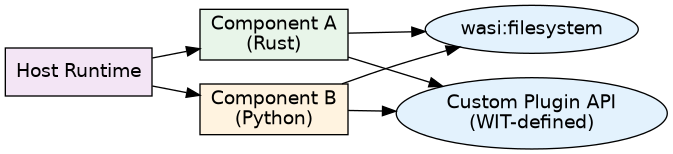
This composability is what makes WASI more than just a sandboxed POSIX replacement. It enables entirely new patterns for building polyglot systems.
WASI in Practice: Real-World Use Cases
Plugin Systems
WASI provides a secure, portable way to implement plugin architectures. Products like Envoy Proxy, Shopify Functions, and Fastly's Compute platform use WASI-based Wasm modules to run third-party code safely in production.
Serverless and Edge Computing
Platforms like Fastly Compute, Cloudflare Workers, Fermyon Spin, and AWS Lambda are adding WASI support. WASI modules start in milliseconds, consume minimal memory, and can be distributed globally with zero cold-start penalty.
Blockchain and Smart Contracts
Projects like NEAR Protocol, Polkadot (Substrate), and Cosmos (CosmWasm) use Wasm as their smart contract execution format. WASI provides the standard interface these contracts use to interact with the blockchain runtime.
Embedded and IoT
WASI's small footprint and sandboxing make it ideal for IoT devices. A WASI module can run on a microcontroller with limited resources while being restricted to exactly the system resources it needs.
Command-Line Tools
The WASI SDK and toolchains like cargo-component allow developers to build command-line tools as WASI modules. These tools are portable across Linux, macOS, Windows, and even embedded systems without recompilation.
WASI Runtimes and Toolchains
Several runtimes support WASI today:
| Runtime | Language | Key Features |
|---|---|---|
| Wasmtime | Rust | Reference WASI implementation, Bytecode Alliance |
| WasmEdge | C++ | Edge-optimized, ML inference support |
| Wasmer | Rust | Package manager (WAPM), multiple compilers |
| wazero | Go | Zero dependencies, embedded-friendly |
| V8 | C++ | Google's engine, experimental WASI support |
| StarlingMonkey | Rust | Embeddable JS+WASI runtime |
On the toolchain side, the WASI SDK provides Clang/LLVM and a sysroot for compiling C/C++ to WASI. The Rust toolchain has built-in WASI support via the wasm32-wasip1 and wasm32-wasip2 compilation targets. The Go community is developing TinyGo support and WASI bindings through wasm-tools.
Security Model and Sandboxing
WASI inherits WebAssembly's sandboxing model and extends it with capability-based security:
- Modules have zero default access to the host filesystem, network, clocks, or environment.
- The runtime grants access explicitly through preopened directories, socket configurations, and environment variable allowlists.
- Modules cannot escape their sandbox. A compromised module can only do what the host has explicitly permitted.
This makes WASI fundamentally different from running a traditional process. In a traditional OS process, a program inherits the full permissions of the user that launched it. In WASI, the program starts with nothing and must be granted specific capabilities.
# Running a WASI module with explicit capability grants
$ wasmtime --dir=.::./my-data --env API_KEY=xxx my-module.wasm

# The module can only access ./my-data and see API_KEY
# No other filesystem paths or env vars are available
Security Warning: While WASI provides strong sandboxing, the security guarantees depend on the host runtime's implementation. Always use a well-audited runtime like Wasmtime, and keep it updated. A sandbox is only as strong as its implementation.
WASI vs Docker vs Native Binaries
Developers often ask how WASI compares to containers and native executables. Here is a practical comparison:
| Property | Native Binary | Docker Container | WASI Module |
|---|---|---|---|
| Start time | Milliseconds | Seconds | Milliseconds |
| Memory overhead | Minimal | Tens of MB | Minimal |
| Portability | Platform-specific | Linux (via kernel) | Truly cross-platform |
| Sandboxing | OS permissions | Kernel namespaces | Built-in, capability-based |
| Security surface | Full system access | Shared kernel | Zero-default-access |
| Ecosystem maturity | Decades | ~10 years | ~3 years (rapidly growing) |
| Binary size | Small | MBs to GBs | Small |
WASI is not a replacement for containers in all scenarios. Containers remain the better choice when you need to run unmodified legacy applications or require deep OS integration. WASI excels when you need fast startup, strong isolation, and cross-platform portability for new applications.
Getting Started: Your First WASI Module
Here is a minimal example of a WASI module written in Rust:
use std::env;
use std::fs;

fn main() {
    let args: Vec<String> = env::args().collect();
    if args.len() < 2 {
        eprintln!("Usage: greet <name>");
        std::process::exit(1);
    }

    let name = &args[1];
    let greeting = format!("Hello from WASI, {}!\n", name);

    // Write to stdout (capability-granted by the runtime)
    print!("{}", greeting);

    // Write to a preopened directory
    if let Ok(mut file) = fs::File::create("greeting.txt") {
        use std::io::Write;
        let _ = file.write_all(greeting.as_bytes());
        println!("Greeting saved to greeting.txt");
    }
}
Compile and run it:
# Compile for WASI preview2
$ cargo build --target wasm32-wasip2 --release

# Run with Wasmtime
$ wasmtime target/wasm32-wasip2/release/greet.wasm -- World

# Output:
# Hello from WASI, World!
# Greeting saved to greeting.txt
This simple example demonstrates WASI's core principles: the module starts with no access, receives arguments from the runtime, writes to stdout, and writes to a specific directory that the runtime grants access to.
Key Takeaways
- WASI is the standard system interface for WebAssembly, enabling modules to interact with files, network, clocks, and environment variables in a portable, secure way.
- Preview2 is the current standard, replacing the older POSIX-like preview1 with a WIT-based interface system that supports async I/O, structured errors, and the Component Model.
- Capability-based security means WASI modules start with zero access and receive explicit, auditable grants from the host runtime.
- WASI is not just for the web: it powers serverless platforms, plugin systems, smart contracts, IoT devices, and portable CLI tools.
- The Component Model enables polyglot composition, where modules written in different languages communicate through shared WIT interface definitions.
- The ecosystem is maturing rapidly with production-ready runtimes like Wasmtime and growing toolchain support for Rust, C/C++, Go, and Python.
Frequently Asked Questions
What is the difference between WebAssembly and WASI?
WebAssembly is a binary instruction format and virtual machine. WASI is a set of standard APIs that define how a WebAssembly module interacts with the host operating system. Think of WebAssembly as the CPU and WASI as the operating system — one provides computation, the other provides system services.
Can I use WASI to run existing server applications?
Not directly. WASI modules must be compiled to Wasm targeting the WASI platform. Existing server applications written in Java, Python, or Node.js would need to be recompiled or rewritten. However, many popular libraries and tools are being ported to WASI targets, and projects like ComponentizeJS are working to bring JavaScript to the Component Model.
Is WASI production-ready in 2026?
Yes. WASI preview2 has been stable since 2024, and major cloud platforms (Fastly, Cloudflare, Fermyon) run WASI-based workloads in production. Wasmtime, the reference runtime, is a mature, well-audited project under the Bytecode Alliance. For most use cases, WASI is ready for production workloads today.
How does WASI handle networking?
WASI preview2 includes the wasi:sockets interface, which supports TCP and UDP sockets. The host runtime grants network access to modules through specific socket configurations. This allows WASI modules to make outbound connections, and with appropriate host configuration, accept inbound connections as well.
Can WASI replace Docker containers?
WASI and Docker solve different problems. Docker packages an entire application with its dependencies into a container image that shares the host Linux kernel. WASI provides a lightweight, sandboxed execution environment for a single module with capability-based security. For new, cloud-native applications — especially at the edge — WASI offers compelling advantages in startup speed and security. For running legacy applications or workloads needing deep OS integration, Docker remains the better choice.
Related Articles
- WebAssembly Beyond the Browser: A Practical Guide to WASM in 2026
- gRPC Essentials: A Practical Guide to High-Performance Remote Procedure Calls
- Edge Computing Explained: A Practical Guide to Processing Data Closer to the Source
- Signals in Frontend Development: The Reactivity Pattern Reshaping Modern Web Frameworks
- Rust Ownership Explained: Memory Safety Without a Garbage Collector


Comments
Post a Comment